
Adam

May 13, 2026
“For since death came through a man, the resurrection of the dead comes also through a man. For as in Adam all die, so in Christ all will be made alive.” – 1 Cor. 15:21-22
There are two men whose decisions altered the course of every human life ever lived.
The first you know by name – Adam.
The second you know by grace – Jesus Christ.
And the story stretching between them is not merely theology. It is our story.
The very name Adam carries its meaning in the soil.
In the Hebrew tongue, adam comes from adamah – ground, earth, dust.
He was the earthling, shaped from the dust, breathed into life by the very breath of God.
There is poetry in that, and there is also warning. What comes from the ground must return to it.
When Adam stood in the Garden of Eden and chose his own will over God’s, something broke that no human hand could mend.
Paul is plain about it in Romans 5:12 – sin entered the world through one man, and death through sin.
Not death as metaphor. Not death as idea. Physical death.
The kind that comes for every one of us – mighty or lowly – without exception, without negotiation.
This is what theologians call ‘original sin,’ and while the language sounds academic, the reality is deeply personal.
Every funeral you have ever attended is Adam’s legacy.
Every grave dug into that same adamah is a reminder that we are bound to a man whose choice preceded our birth by millennia – and yet shapes every one of our days.
This is not comfortable. But it is true. And truth, even when it stings, is always kinder than illusion.
But Paul does not stop with Adam. He cannot, and neither can we.
The Apostle constructs his argument like a master builder – deliberate, load-bearing, nothing wasted.
He sets Adam before us not to despair us, but to frame what comes next.
Because into this world bound by death steps another man. Jesus of Nazareth – who Paul, with breathtaking boldness, calls the Last Adam.
Where the first Adam brought death through disobedience, the Last Adam brings life through obedience.
Let’s live as people who have heard the news from the empty tomb and believed it – completely, joyfully, without reservation.
Where the first man’s fall was universal in its consequence, the Last Man’s resurrection is universal in its offer.
And here we must be precise: the resurrection Paul speaks of is not spiritual sentiment.
It is not a metaphor to make you feel better about life.
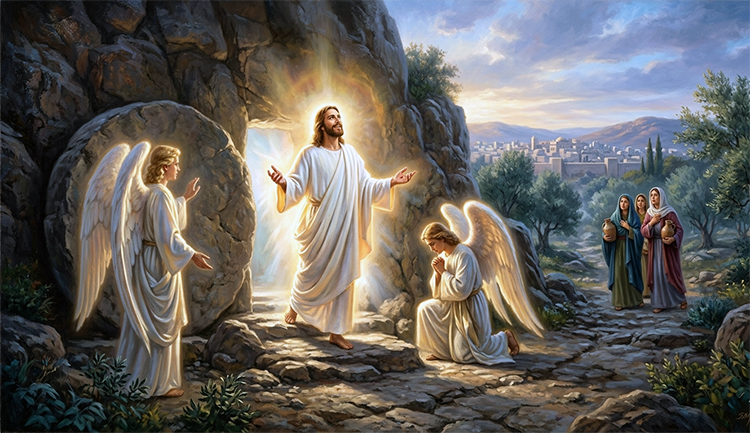
It is bodily resurrection – the same kind Christ himself experienced when the stone rolled away and the tomb stood empty. Paul calls Christ’s resurrection the firstfruits as we saw in the previous meditation.
Christ’s risen body is the down payment on yours. Hallelujah!
This is the anchor of Christian hope.
The same Jesus who was crucified under Pontius Pilate, walked out of the tomb the third day with a body that could be touched, that could eat, that bore the marks of the nails, and a body that ascended into heaven.
If that is true – and everything in the New Testament insists it is – then our own resurrection is not wishful thinking.
It is a scheduled appointment.
So, what do we do with this today?
We live differently because of it.
Paul’s logic is simple and unrelenting: if the dead will be raised, then how we live matters eternally.
Our bodies matter. Our relationships matter. Our integrity, our worship, our service, our love – none of it is wasted.
So live holy. Live purposefully.
Live as people who have heard the news from the empty tomb and believed it – completely, joyfully, without reservation.
Adam gave us death.
Christ gives us life.
And that life begins now.